
Outrigger canoe, Kallady, Batticaloa, Sri Lanka. Almost all of the photographs were taken by the owner of this blog and are his property.Click on each picture below to see an enlarged view.
Tuesday, December 24, 2013
Kanthaka Chaithya, Mihinthale, Sri Lanka.
This summary is not available. Please
click here to view the post.


Thursday, December 19, 2013
Kanthaka Chathya, Mihinthale, Sri Lanka.


Kantaka Chethiya was renovated in 1930′s to the current status.
When this stupa was discovered, it has been a just a mound of earth covered by
various debris. This has been known as the Kiribadapavu Dagaba, Kiribat Vehera,
or Giribhanda during this time. But a stone inscription found close by has
identified the original name of this stupa as Kantaka Chethiya.
It is
unknown who built this stupa but it is said that the King Lanjatissa (119-109
BC) has built a stone mantel built for this stupa. Therefore we can assume that
the stupa was built prior to 119 BC. The present stupa is 425 feet in diameter
and is about 40 feet high. This stupa is most popular for one of the most well
preserved vahalkada which can be seen today.


Sights at Mihinthale, Anuradhapura, Sri Lanka.
 |
| A mini-stupa made of baked bricks. |
 |
| Stone pillars of the alms-hall. |
 |
| A water conduit made from stone, the equivalent of a GI or plastic pipe of today. |

Wednesday, December 18, 2013
Mihinthale sights, Anuradhapura, Sri Lanka.


'Buddhism was
introduced to Sri Lanka at Mihintale in 247 B.C. King Devanampiyatissa of Sri
Lanka, who was on a hunting expedition, became a disciple of Buddha after the
Buddhist missionary Mahinda preached a sermon. He was followed by his queen,
his ministers, officials and the people. Mihintale thus became historically and
religiously significant, and ever since it annually attracts pilgrims during
the June full moon to commemorate the official introduction of Buddhism to Sri
Lanka. To accommodate the lay and scholarly interest in Mihintale, both the
sacred area and the town have undergone several phases of development, including
a site museum. A rock inscription records the finest description of the running
of a monastery in the 9th century A.D. It refers to the 200 or more serfs who
assisted the religious congregation of 2,000. It also records the salaries paid
to the physician, the surgeons, the teachers, potters, cooks and other workers.
The lay assistants were instructed to submit the list of expenditures once a
week, a summary of accounts at the end of each lunar month, and a balance
sheet at the end of each year.
Refectory hall
(left), stone inscriptions (above) and the relic chamber (below) at Mihintale
where Buddhism was introduced to Sri Lanka by Prince Mahinda, the son of Indian
Emperor Ashoka, in 247 B.C.'
Tuesday, December 17, 2013
The caves at Mihinthale, Anuradhapura, Sri Lanka.
 |
| Caves used by Buddhist Monks in ancient times. |
 |
| Stone stairway leading to the 'Kanthaka Chaithya'. |

‘In
the 3rd century BC, area of Mihinthalawa was a thick jungle area inhibited by
wild animals and was a hunting ground reserved for the royals. All this
changed in 250 BC when the son of the Indian Emperor Asoka, Mahinda Maha
Thero arrived at the Missaka Pauwa to meet king Devamnampiyatissa for the
first time and asked the famous questions to decide whether he is intelligent
enough to understand the philosophy of the Buddha. Initially Mahinda Maha
Thero’s residence, but later Mihinthale became a main centre for Theravada
Buddhism.
Mihinthale
is a collection of four mountains each about 1000 feet in height. They are
1. Mihinthalawa
2. Ath Vehera mountain
3. Anaikutti mountain
4. Rajagiri Lena mountain
Mihinthalawa
is the main mountain and where the Aradhana gala (The rock of invitation) and
the main Mahaseya stupa is situated’.
|
 |
| A flower seller at the beginning of the ascent to Mihinthale. |
Monday, December 16, 2013
The 'Samaadhi Buddha statue', Anuradhapura, Sri Lanka.
 |
| The 'Samaadhi Buddha' statue. |
 |
| Rear view of above. |
 |
| A vandalized statue behind the 'Samaadhi Buddha' statue. |

Sunday, December 15, 2013
Abheyagiri sights, Anuradhapura, Sri Lanka, Sankha, Padhma, Guardian Spirits.


 |
| 'Padma Guardian Spirit''? |
 |
| 'Shanka guardian spirit'? |
'Sri Ram asked Agastya--'Who was Ravana -- the tormentor of
deities? I am anxious to know about the origin of his whole clan."
Sage Agastya replied--Vishrava
was the grandson of Lord Brahma. His father was sage Pulastya. Vishrava had two
wives--Mandakini and Kaikasi. Mandakani's son was Kubera while Kaikasi was the
mother of Ravana, Kumbhakarna and Vibhishan. Kubera ruled over Lanka. One day,
Kubera, came to see his parents boarded on his aircraft--Pushpak Viman. After
he returned to Lanka, Ravana, who was very much impressed by Kubera's royal
appearances asked Kaikasi--"Who was this fellow? From where did he acquire
such an amazing aircraft."
Kaikasi revealed to Ravana that
the guest was none other than his step-brother Kubera. She said--"Kubera
is the son of your step mother--Mandakini. He has made his mother proud by his
conduct but I am ashamed of you, because of your inconsequential existence. You
are no better than a worm."
Ravan decided to prove his
mother wrong by acquiring insurmountable power and authority. Ravana went to
the forest and performed an austere penance for ten thousand years by standing
on one foot. He fixed his gaze at the sun and never for a moment did he remove
his gaze from it. Kumbhakarna and Vibhishan also engaged themselves in austere
penance. At last, Lord Brahma became pleased and blessed Ravana with a vast
kingdom. Ravan then started tormenting his step-brother Kumbhakarna. He
snatched Kubera's Pushpak Viman and drove him out of Lanka. Ravan then turned
his attention towards the deities and drove them out of heaven. The deities
went to seek the help of Lord Brahma who in turn took them to Lord Shiva. Even
Lord Shiva was clueless about the means by which the indomitable Ravana could
be subdued. Ultimately all of them including Lord Shiva went to Lord Vishnu and
sought his help'...
'In the context of Hindu mythology, Nidhi, that is, a treasure,
constituted of nine treasures (nawanidhi) belonging to Kubera (also spelt as Kuvera), the god of wealth.
According to the tradition, each nidhi is personified as having a guardian
spirit, and some tantrikas worship them. The nature and characteristics of
nidhis have remained largely unexplained and have not been fully understood.
According toAmarakosha, the nine nidhis are:
-
mahapadma "great lotus flower"
- padma
"lotus flower"
- shankha
"conch"
- makara
"crocodile"
-
kachchhapa "tortoise"
- mukunda
"a particular precious stone"
- kunda
"jasmine"
- nila
"sapphire"
- kharva
"dwarf"
Saturday, December 14, 2013
'Magic Pinsala' - 'The magic brush', A Sinhalese Children's play.
I made this video from a performance at the Town Hall,
Avissawella, Sri Lanka. The performance was by the children of Sumedha
Vidyalaya, Kosgama. The title of the play was 'Magic Pinsala' -- 'The Magic
Brush'. It tells the story of a child
having a magic brush which brings to life everything that she paints with it. A
feudal Lord forces her to paint a mountain of gems. The child paints an island with a mountain of
gems. On request she paints a boat for the Lord to cross across the waters to
reach the island of gems. While the Lord and his retinue are in the boat, the
child paints a severe tempest. The cruel Lord and his accomplices drown when
the boat buffeted by the storm, breaks up.
I filmed this from the front row with no floodlights. The camera was a Nikon
D90 in video mode.
http://youtu.be/xi6KvUUPtT0Friday, December 13, 2013
Abhayagiri, Anuradhapura, Sri Lanka.


Abhayagiri Vihāra was a major monastery site of Theravada Buddhism that
was situated in Anuradhapura, Sri Lanka. It is one of the most extensive
ruins in the world and one of the most sacred Buddhist pilgrimage
cities in the nation. Historically it was a great monastic centre
as well as a royal capital, with magnificentmonasteries rising
to many stories, roofed with gilt bronze or tiles of burnt clay glazed in
brilliant colors. To the north of the city, encircled by great walls and
containing elaborate bathing ponds, carved balustrades and moonstones, stood
"Abhayagiri", one of seventeen such religious units in Anuradhapura
and the largest of its five major viharas. One of the focal points of the
complex is an ancient stupa, the Abhayagiri
Dagaba. Surrounding the humped dagaba, Abhayagiri Vihara was a seat of the
Northern Monastery, or Uttara Vihara.
The term "Abhayagiri
Vihara" means not only a complex of monastic buildings, but also a
fraternity of Buddhist monks, or Sangha, which maintains its own historical records,
traditions and way of life. Founded in the 2nd century BC, it had grown into an
international institution by the 1st century AD, attracting scholars from all
over the world and encompassing all shades of Buddhist philosophy. Its
influence can be traced to other parts of the world, through branches
established elsewhere. Thus, the Abhayagiri Vihara developed as a great
institution vis‑a‑vis the Mahavihara and
the Jetavana Buddhist
monastic sects in the ancient Sri Lankan capital of Anuradhapura.
http://en.wikipedia.org/wiki/Abhayagiri_vih%C4%81raThursday, December 12, 2013

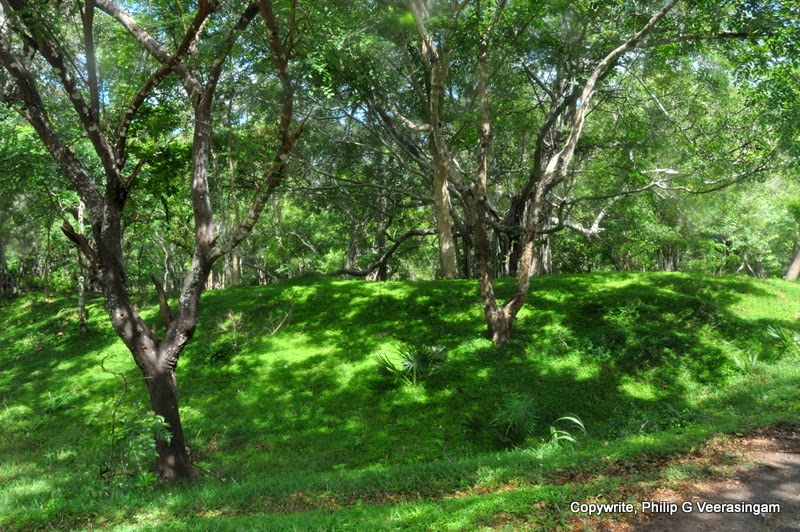


Wednesday, December 11, 2013
Lankarama, Elephant bath, Anuradhapura, Sri Lanka.
 |
| The Lankarama Chaithya. |
 |
| A boundary wall of bricks. |
 |
| Underground water outlet into a pool. |
 |
| The Elephant Pond ('Aeth pokuna' S) |
'Eth pokuna (Elephant pond) is an
ancient man made pond situated close to Lankaramaya. It is 159 meters in length
52.7 meters across and 9.5 meters in depth with the holding capacity of 75,000
cubic meters of water.
The water
to this pond has been supplied from the Periyamkulama Tank through a network of
underground canals. These underground canals still work after so many hundreds
years. This tank probably has been used by the monks in the Abhayagiri
Buddhist Monastery who
amounted over five thousand priests'.
Tuesday, December 10, 2013
'Lankaramaya', Anuradhapura, Sri Lanka.


'The last of the holy sites
of Atamasthana (Eight Holy Places) is the little known stupa, Lankaramaya. It
is believed this stupa was built by King Vattagamini Abaya (Valagamba) in the
1st century BC.
According to some sources, the ancient name of the stupa and the surrounding temple complex was 'Silasobbha Khandaka Cetiya.' The legend says King Valagamba was hiding in a place called Silasobbha Khandaka during South Indian Chola invasions. After defeating the invaders and regaining power in Anuradhapura, the King had built a stupa at the place where he was hiding and named it 'Silasobbha Khandaka Cetiya.'
However, very little is known about the original form or how it came to be known as Lankarama Stupa. According to archaeological evidence, the stupa had undergone a series of renovations and the present day stupa is quite similar in form and structure to Thuparama, the first stupa built in Sri Lanka after Buddhism was introduced here.
Lankarama too has evidence of a magnificent vatadage (house built encircling the stupa) and there are indications that there were 88 stone pillars supporting the roof of the vatadage. However, today, only a few of those pillars are remaining.
The stupa is quite small in size when compared to giants in Anuradhapura such as Jetavanaramaya, Abhayagiriya or Ruwanvelisaya, with only a diameter of 45 feet (14 metres).
The stupa is standing on a circular courtyard, raised 10 feet (3 metres) above ground, and with a diameter of 1,332 feet (406 metres).'
According to some sources, the ancient name of the stupa and the surrounding temple complex was 'Silasobbha Khandaka Cetiya.' The legend says King Valagamba was hiding in a place called Silasobbha Khandaka during South Indian Chola invasions. After defeating the invaders and regaining power in Anuradhapura, the King had built a stupa at the place where he was hiding and named it 'Silasobbha Khandaka Cetiya.'
However, very little is known about the original form or how it came to be known as Lankarama Stupa. According to archaeological evidence, the stupa had undergone a series of renovations and the present day stupa is quite similar in form and structure to Thuparama, the first stupa built in Sri Lanka after Buddhism was introduced here.
Lankarama too has evidence of a magnificent vatadage (house built encircling the stupa) and there are indications that there were 88 stone pillars supporting the roof of the vatadage. However, today, only a few of those pillars are remaining.
The stupa is quite small in size when compared to giants in Anuradhapura such as Jetavanaramaya, Abhayagiriya or Ruwanvelisaya, with only a diameter of 45 feet (14 metres).
The stupa is standing on a circular courtyard, raised 10 feet (3 metres) above ground, and with a diameter of 1,332 feet (406 metres).'

Above photo from - http://www.sinhalaheritage.org/Anuradhapura/Lankarama.html
Subscribe to:
Comments (Atom)