Monday, June 30, 2014

Scenes of Thondamanaru, Jaffna, Sri Lanka.

The road to 'Uppumaal' beach. Rev Peto, Principal of the St.John's College, Jaffna, was carried away by the current and died while swimming here in the 1940s. Mr. Navaratnaswamy who swam across the Palk Straight to India in the 1950's, also died here of a heart-attack, while practicing to row round the Island in a 'Kattumaram'.
The new bridge spanning the Thondaiman Aru.

A view of the 'Sinna kadatykarai' from the new bridge. You can see the posts in the water, the only remaining parts of the old wooden bridge of the 1940s.

The junction of the Thondaiman Aru wiith the Palk Straight.
 These pictures bring to mind the following poem which we memorized at school.
HOME NO MORE TO ME
by: Robert Louis Stevenson


    OME no more home to me, whither must I wander?
    Hunger my driver, I go where I must.
    Cold blows the winter wind over hill and heather;
    Thick drives the rain, and my roof is in the dust.
    Loved of wise men was the shade of my roof-tree.
    The true word of welcome was spoken in the door--
    Dear days of old, with the faces in the firelight,
    Kind folks of old, you come again no more.
     
    Home was home then, my dear, full of kindly faces,
    Home was home then, my dear, happy for the child.
    Fire and the windows bright glittered on the moorland;
    Song, tuneful song, built a palace in the wild.
    Now, when day dawns on the brow of the moorland,
    Lone stands the house, and the chimney-stone is cold.
    Lone let is stand, now the friends are all departed,
    The kind hearts, the true hearts, that loved the place of old.
     
    Spring shall come, come again, calling up the moor-fowl,
    Spring shall bring the sun and rain, bring the bees and flowers;
    Red shall the heather bloom over hill and valley,
    Soft flow the stream through the even-flowing hours;
    Fair the day shine as it shone on my childhood--
    Fair shine the day on the house with open door;
    Birds come and cry there and twitter in the chimney--
    But I go for ever and come again no more.

'Home No More to Me' is reprinted from An Anthology of Modern Verse. Ed. A. Methuen. London: Methuen & Co., 1921.

Read more at http://www.poetry-archive.com/s/home_no_more_to_me.html#bU7Sd8SZJAA06Qsh.99

Saturday, June 28, 2014

Scenes of Jaffna town, Sri Lanka.

Public Library.

St James' Church.


The name 'Pattinam' was used to refer to the Jaffna town by the older generation. 'Pattinam' in old Tamil usage referred to a town situated by the sea-shore ( Cf 'Kaavirippoom Pattinam' referred to in the tamil epic 'Manimekalai' written in the 2nd Century AD). The Dutch built a large Fort which served as their administrative center in the north of Sri Lanka.

Friday, June 27, 2014

House-hold items of Jaffna 60 years ago, Sri Lanka.

Wooden spatula used to stir up rice while cooking.

Various utensils of brass.

A kite.

A large bucket of iron used in the irrigation of farm land.

Thursday, June 26, 2014

Scenes of Jaffna in the 1950s; Sri Lanka. Exhibit at the Gnanam's Hotel.


A water-boiler used in a tea-shop.

A farmer returning after work.

A wooden plough.

Kitchen utensils made of granite.
Everything was used, repaired and passed on from generation to generation. The throw-aways were minimal and were bio-degradable. Life centered on the villages where every need was met.

Wednesday, June 25, 2014

House-hold utensils used in Jaffna in the pre 1950 era, Sri Lanka.

Charcol fired irons, various brass utensils, water carriers and table lamps.

A balance and a water-carrier made from palmyra leaf.
These exhibits were found at Gnanam's Hotel, Jaffna. In the pre 1950 era most of the cooking utensils were either of clay or brass. Aluminium was unheard of.

Tuesday, June 24, 2014

A Gypsy fortune-teller, Avissawella, Sri Lanka.


She was from a Gypsy tribe long resident in Sri Lanka. They speak a different language and never stay in one place. They appear literally overnight and build a temporary camp in a vacant plot. They visit the adjoining villages.The males exhibit Cobras and trained monkeys. The females are palmists and fortune tellers. They have an annual get to-gether at Galgamuwa close to Anuradhapura where the tribal elder ratifies marriages and settles internal disputes.

Monday, June 23, 2014

Environs of the Dutch Fort, Jaffna, Sri Lanka.

'Pannai' sea-shore.

Area in front of the Fort.

Sunset over the Fort.

The Telecom tower near the Fort.
The Fort is being renovated on a grant from the Dutch Government.

Saturday, June 21, 2014

Anuradhapura and Mihinthale, Sri Lanka.

The 'Kotha' of 'Ruwanweli-saeya' seen over the trees.

Environs of Mihinthale.

The A9 highway from Jaffna to Kandy bordering Mihinthale.

A figure with a votive lamp by the side of the highway.

Friday, June 20, 2014

Gem museum, Batugedera, Rathnapura, Sri Lanka.

Cross-section of a gem-pit'.

Photo of workers in a gem-pit.
The famous 'Arabian Nights' has a story of gems most probably relating to Rathnapura of Sri Lanka. It goes as follows.
There is an inaccessible valley in these parts, whose bottom is strewn with gems of every hue and colour. Pieces of fresh meat on which a sticky gum from a tree in these parts (most probably the Jak or 'Kos' tree) is smeared and is thrown down into the valley by the natives. Scores of a large bird called a 'Roc' by the natives (?'Brahminy Kite') swoop down, pick these pieces of meat with the gems adhering to it and carry them to their nests to feed their young. These nests are then raided by the locals and the gems picked out to be sold by them.
Rathnapura is the land famed for gems from time immemorial. Foreign merchants, Arabs, Persians, Indians, and Chinese used to travel up the Kalu Ganga by boat from Kaluthara on the western sea-board of the Island, to Batugedera in Rathnapura. The two targets of these travelers was to climb the holy Adam's Peak also known as Sri Pada and to buy gems which were mined in the area.
Now there is a superb highway from Colombo to Rathnapura roughly a 100Km distance. From Rathnapura which has a thriving market in uncut gems, to Batugedera is about 3 Kilometers on the Badulla highway. The Gem Museum at Batugedera is on the left hand side of the road. It is owned and managed by Mr. Bodhi Amerasinghe who has a degree in Gemmology from Germany, his charming wife Wimala and daughter Palika who also has a degree in Gemmology from Germany. They have a nice museum exhibiting the different varieties of gems. They also have a sales point where jewelry using gems mined locally to suit the tastes of tourists is found. These items of jewelry are produced here and a guarantee card is given with each item of jewelry. This place is well worth a visit.

Thursday, June 19, 2014

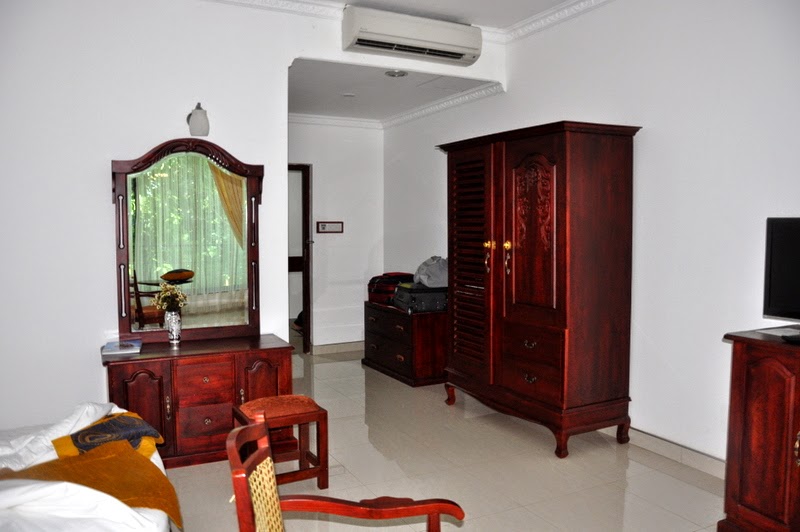
Inside the 'Centuria Lake Resort', Embilipitiya, Sri Lanka.


A star class hotel in the once desolate town of Embilipitiya, shows the degree of development that this area has undergone over the past decade.

Monday, June 16, 2014

Milk feeding time, Elephant Orphanage, Udawalawe, Sri Lanka.

The orderly entry of the young elephants.

The feeding of milk.

The fight for a place in the queue.
Videos taken by me a few years ago:-


1. http://youtu.be/GM31sVP8NMA - 'Give me more milk'

2. http://youtu.be/xtNwPei39xY - Jumping the fence to get more milk.


Video taken by me on June 2014:-